As a new journey begins in summer, we stay committed to our original aspirations through dedicated action. To further standardize clinical management of interns, help newly enrolledinterns quickly adapt to their new roles and the clinical working environment, build strong foundation for clinical training, and reinforce their commitment to the values and responsibilities of medical professionals, the Research& Teaching Department of the Fourth People’s Hospital of Shenzhen organized a pre-med training for 2026 interns on June 4–5, 2026, at the Lecture Hall 306 of the Management Building.
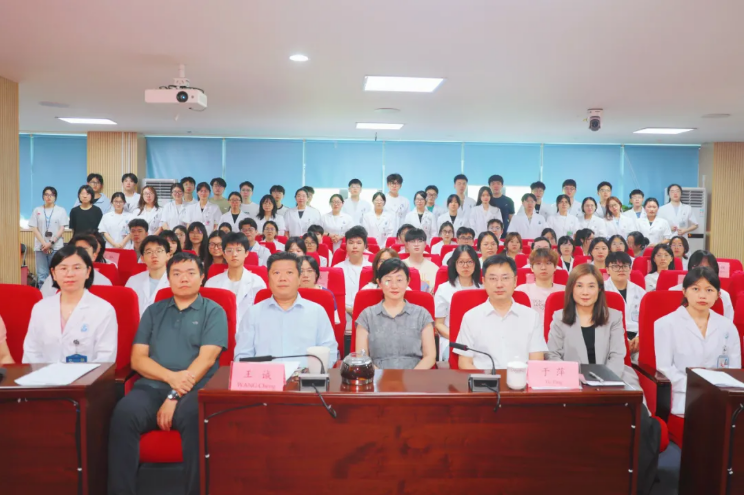
CPCSecretary WANG Cheng, YU Ping, Deputy Hospital Directorin charge of research and teaching, and heads of relevant departments including the Medical ServicesDepartment, Research& Teaching Department, and Finance Department attended the opening ceremony, which was presided over by YUAN Bo, Director of Education Office. The opening ceremonybegan with all interns watching the hospital’s introductory video, giving them a comprehensive overview of the hospital’s developmenthistory, distinctive specialties, and the mission of medical professionals.
At the opening ceremony, Director YUAN Bo extended her sincere and warm to all interns comingto the hospital for their internships. She noted that clinical internship represents a critical stage in which medical students transition from the classroom to frontline clinical practice, and from theoretical learning to hands-on skills development and clinical thinking training. This process is not only essential for improving professional skillsbut also represents a critical first step toward cultivating professional ethics and a sense of responsibility.Sheemphasized that the hospital has always placed great importance on medical education and talent development, and is committed to providing interns with a high-quality platform for learning and clinical practice. She then introduced the core curriculum of the pre-internship trainingin detail, which was designed to help students adapt to the clinical environment as quickly as possible, consolidate their professional foundation, and successfully embark on a new chapter of their internship journey.

Deputy Hospital DirectorYU Ping, who oversees researchand teaching, delivered a speech. She said that everyone had gathered here because of their shared aspiration to become medicalprofessionals. This internship training is not only a basic introduction to clinical procedures and skills, but also a carefully designed guide for their professional growth. She encouraged all interns to continuously enhance their professional skills while cultivating compassion and a humanistic approach to healthcare. They should remain attentive to patients’ needs, convey the warmth and care of medicalprofessionals, embrace innovation with courage, and develop resilience.Throughout their internships, they should strengthen their ability to cope with pressure and develop clinical thinking, and strive to become lifelong learners, problem solvers, and those who bring warmth and comfort to patients. Like nerve endings that sensitively perceive pain signals, they should remain highly attentive to patients’ suffering, wholeheartedly safeguard patients’ health, and demonstrate the professionalism and integrity expected of future physicians through every word and action.

CPC Secretary WANG Cheng delivered concluding remarks. He emphasized that clinical internship represents a critical stage in medical students’ growth into clinical physicians and marks an important first step for their professional careers. He noted that the hospital is a comprehensivemedical institution jointly established through Sino–foreign cooperation. Leveraging its leading strengths in neuroscience, the hospital has a complete range of specialties and rich teaching resources, providing an excellent platform for interns’growth and development. He also put forward three expectations for young medical students: First, they should strengthen their values and sense of responsibility, cultivate a strong commitment to serving the country and society, and integrate their ideals and beliefs into their medical careers. Second, they should remain dedicated to learning and critical thinking, continuously improve their clinical skills, engage in medical research, and gain practical experience through case-based practice and patient communication. Third, they should uphold professional standards, maintain medical ethics and integrity, and remember that the foundation of being a physician lies in serving patients wholeheartedly with excellent medical expertise. Finally, he wished all interns a rewarding and successful experience at the hospital and hoped they would have a fulfilling and unforgettable clinical internship journey.

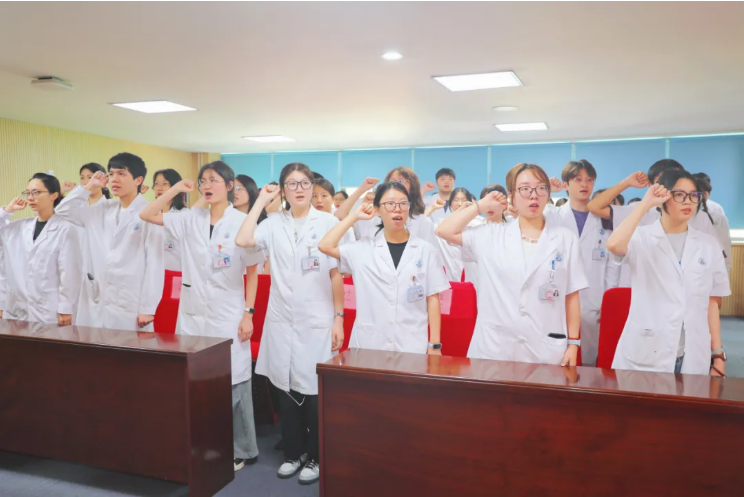
With solemn vows reflecting their original aspirations and sincere dedication demonstrating their sense of mission, all newinterns took the physician’s oath under the guidance of WANG Yanhua from the Obstetrics Division. Dressed in white coats, the interns stood upright with their right hands raised as their powerful vows echoed through the room. Every word carried weight, demonstrating young medical students’ respect for life, commitment to medical ethics, and dedication to developing their professional skills and shouldering the responsibilities of future medical professionals.
This training session brought together multiple functional departments, including Medical Services Department, Hospital Infection Control Group, Administrative Group, and Safety & Security Group, to deliver a comprehensive and practical curriculum. The training covered a wide range of essential topics, including medical ethics and professional conduct, healthcare laws and regulations, hospital internship management policies, research integrity, emergency response skills, infection prevention and control, medical record writing standards, psychological support for interns, fraud prevention awareness, and fire safety.Through this systematic training, interns acquired the essential knowledge and skills required for clinical practice, gained a clearer understanding of compliance requirements and workplace standards for internships, laying a solid foundation for safe and standardized clinical internships.
As the training concluded, a new journey guided by their original aspirations began. The participating interns expressed their commitment to remembering the oath they had taken, strictly following professional standards, and putting what they learned during the training into practice. They pledged to continue learning and honing their skills on the clinical frontline, cultivate professional integrity, continuously improve their capabilities, safeguard public health through their medical expertise and youthful dedication, and fulfill the responsibilities and mission of medical students in the new era.
Copyright © 2018 SHENZHEN SAMII MEDICAL CENTER 粤ICP备19008291号


Official WeChat Service Account